Thirty Baht to Belong: What Chiang Mai's Red Trucks Taught Me About Actually Living Here
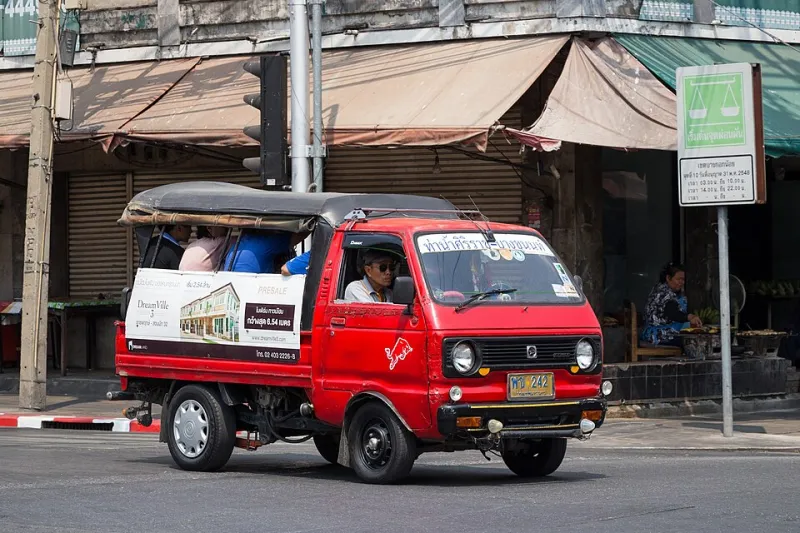
Photo: Ilya Plekhanov, CC BY-SA 4.0, via Wikimedia Commons
My first week in Chiang Mai, I spent about $40 on ride-hailing apps. My third week, I spent about $6 total, and most of that went to iced coffee. The difference? I finally figured out the songthaew.
If you haven't seen them yet, you will: red pickup trucks with a canopy over the bed, two bench seats, and a hand-painted sign in Thai script propped against the windshield. They're part bus, part shared taxi, part rolling neighborhood gossip exchange. And they cost 30 baht — under a dollar — for most rides inside the old city and surrounding neighborhoods.
But here's the thing nobody tells you: the songthaew isn't really about transportation. It's about the moment you stop being a visitor who gets shuttled around and start being someone who lives here. Grab is a transaction. A songthaew is a small, ongoing negotiation with the city itself.
The Basics, Minus the Panic
Let's demystify this immediately, because the first time I stood on the curb watching one of these trucks rumble past, I froze like I'd been asked to defuse something.
Hailing one: Make eye contact with the driver and raise your hand slightly — a casual wave, not a full taxi hail. If there's room and your direction roughly matches theirs, they'll slow down. If they keep going, no offense taken. There's always another one in ninety seconds.
Asking where they're going: Lean toward the driver's window (or just make eye contact in the mirror) and say the name of where you want to go, with a rising, questioning tone. "Tha Pae?" If they nod or wave you in, hop in the back. If they shake their head or quote a big number, they're running it as a private hire — pass and wait for the next one.
Paying: The standard fare inside the city and between the old city, Nimman, and the riverside areas is 30 baht per person. Pay when you get off, walk up to the driver's window, and hand it over. Have small bills. Drivers will not chase you for exact change, but they also won't love you.
The Unwritten Rules Nobody Hands You
There's a rhythm to songthaew etiquette, and you'll pick it up fast — but here's the cheat sheet:
- Ring the buzzer or knock on the cab's wall when you want to get off. There's no stop button. A firm knock works.
- Sit where there's room, scoot when there isn't. The benches fit more people than physics suggests. You will be knee-to-knee with a monk, a grandmother with market bags, and a backpacker with a surfboard (a story for another time). It's fine. Everyone scoots.
- Don't treat it like a private taxi unless you've agreed on a private-hire price up front. The 30-baht system only works because everyone plays by it.
- Luggage is a negotiation. One backpack, no problem. Two suitcases and a bike? Expect a quoted price, and it won't be 30 baht.
Reading the Routes Without Reading Thai
Officially, songthaews run numbered routes — the red ones in central Chiang Mai are mostly the inner-city loops. Unofficially, the system runs on driver judgment, which means a truck might deviate a few blocks to drop someone closer to home. This is not a flaw. This is the feature.
A few routes worth knowing cold:
- Old city to Nimmanhaemin: The classic laptop-and-latte run. Easy, frequent, and the 30-baht fare is basically a law of nature.
- Warorot Market (Kad Luang) runs: These trucks thread through the local neighborhoods most visitors never see. Ride one just to look around.
- Doi Suthep: The trucks at the bottom of Huay Kaew Road run up the mountain for around 60-80 baht per person when shared. The drive up those curves is half the experience.
Pro tip from someone who learned the hard way: screenshot where you're going in Thai script. Drivers aren't tour guides, and my mangled pronunciation of "Wat Phra Singh" once got me dropped at a 7-Eleven a full kilometer away. No harm done — but the screenshot would've fixed it.
Why This Matters More Than the Money
Look, the savings are real. A month of songthaews costs less than three days of ride-hailing. But that's not why I'm writing 800 words about pickup trucks.
The first time you share a bench with a grandmother who nods at your terrible Thai, or a kid who points out where you should get off because you look lost, something shifts. You're not being delivered to an experience — you're moving through the city the way it actually moves. You notice the morning market stalls being set up. You learn which intersection always snarls around 5 p.m. You develop opinions about traffic like a person who lives somewhere.
That's the whole idea behind slow travel, isn't it? Not seeing more, but seeing differently. The songthaew forces you into the city's tempo. Sometimes you wait five minutes in the heat. Sometimes the route takes a detour. Sometimes you end up in a neighborhood you didn't mean to visit and find the best khao soi of your trip.
A taxi gets you there. A red truck teaches you where "there" is.
Your First Ride, Simplified
If you take one thing from this: just do it. Stand on a road near the moat, raise a hand at the next red truck, say "Tha Pae Gate?" with a hopeful shrug, and climb in. Worst case, you're out 30 baht and you've seen a few new streets. Best case, it's the moment Chiang Mai stops being your destination and starts being your city.
Mine was somewhere around week three, wedged between two market vendors and their baskets of longans, bouncing down a soi I couldn't name, realizing I hadn't opened a map app in days.
That's when you know you've made it.